| HOME |
Diversity in the Jarrah Forest

Landforms, Soil and Climate
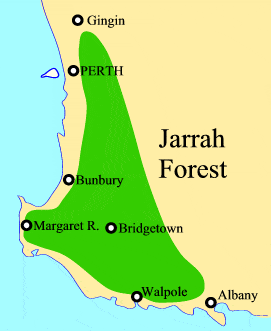 |
Jarrah forest exists only on the western edge of the Darling Plateau in the South West Division of Western Australia.
When looking for the causes of the great biological diversity in the jarrah forest, it is necessary' to go back to the formation of the soil on the landforms it grows out of, under the influence of a changing climate.
Its soils have been weathered from the rocks beneath the plateau they created 4500 million years ago to the earth's foundation. They are called the Yilgarn Block.
The Yilgarn Block has remained in the place where it was born when rocks first hardened on earth. It has never been upheaved by underlying earth movement nor the soil renewed in any way.
Consistent weathering, by rain, wind and sun, from earth's foundation onwards produced a laterised soil profile. That is, a 'duricrust' {cemented gravel) mantle, covering a clay layer that rests on basement rock.
Yet there is considerable soil
variation through the jarrah forest area. It's caused partly by the
nature of the parent rock. And also by the landforms and climate. Upland
soils usually differ from those in the valleys; the degree of slope,
drainage, position in the rainfall range and many other factors have
resulted in an array of soils.
Plant Diversity
It's an evolutionary miracle
that a healthy' forest occurs on the low nutrient Darling Range soils.
There are about 850 known plant species in the jarrah forest; probably more unknown species.
One reason for this remarkable floristic diversity is the region's stable geological history. While it produced leached out lateritic soils, it favoured an orderly process of vegetation changes, i.e. plant succession.
Plants such as Podocarpus are relics of the Jurassic age. Others belong to the early Tertiary. These are relics of species that existed 160 million to 45 million years ago.
Plant systems that developed over such long and undisturbed periods evolved some very advanced adaptations to cope with deteriorating soils and changing climate.
The jarrah tree itself is an example of adaptation to poverty, in that it has evolved a way to conserve nutrients by redistributing them internally from older to younger tissues.
Forest complexity is evident in that there are no sharp or easily detected boundaries between most plant communities. Edges of granite outcrops are one exception. From one spot different sorts of jarrah forest can be seen all over the place. Species come and go. The changes are related to varying depths of soil, natural fertility, slope, aspect and rainfall.
This complexity is unique and fascinating. Especially as the plant communities are involved in an extraordinary network of interactions with other forest inhabitants; all kinds of animals, fungi and microscopic organisms. They help each other survive in the poor soil conditions from which the food chain originates.
Although there is some information available on the jarrah forest's community organisation comparatively little is known of it.
Animal Diversity
The canopy, (overstorey),
and understorey provide food and homes for insects, especially leaf-eaters,
and spiders. Invertebrates include insects, mites, worms, springtails,
slaters, spiders and others that live on the forest floor among the
leaf litter.
Although there have been many studies done of jarrah forest invertebrates, not a lot is known about their function m tire ecosystem. Some ants spread seeds and also eat them. Many species are involved in decomposing the leaf litter. They in turn provide food for birds, reptiles and some mammals.
The relationship of birds with differing vegetation communities is not clear hut the general conclusion seems to be that most forest birds are habitat generalists. They find their food within a broad range of species eating either seeds, or honey bearing flowers, insects or other small animals. They nest wherever they can in the forest, often using tree hollows.
Mammals, especially the smaller ones, tend to have a more delicate relationship with their environment. The chuditch, numbat, woylie, tammar and bushrat have declined in numbers drastically since the forest has been disturbed. Some, such as the woylie, are fungus eating animals and have an important role in nutrient recycling. Jarrah trees depend on particular fungi for essential food elements.
Animals spread fungal spores through the forest. Some of these fungi grow in a mutually beneficial partnership with the roots of trees.
Mammals, such as the numbat, need fallen logs for shelter and wood debris to harbour the termites they eat. The common brushtail, western ringtail and honey possums are tree dwellers, sheltering in hollows that are formed in very old trees.
Biodiversity
Biodiversity can be defined
as the sum total of all the plant, animal, fungi, and microorganisms
that live in the jarrah forest. The basic unit of biodiversity is the
species. Each different kind of organism is a member of a species. Species
are grouped in genera {singular: genus). For example jarrah is called
Eucalyptus marginata. Eucalyptus is the genus, marginata is the
species.
Combinations of many species make up communities and communities are combined in regional units called ecosystems. The whole jarrah forest can be considered an ecosystem.
Species do not exist in a vacuum. Any understanding of biodiversity must include the interactions of the species within the communities in which they naturally occur, and also their interactions with the environment which surrounds them. This includes the soil, climate, landscape and so on.
Although there is some information available on the interactions within communities in the jarrah forest, there are still many gaps in our knowledge. Until more is known, the precautionary principle should be applied wherever human interference disturbs the natural forest. The precautionary principle means erring on the side of caution where there is no clear biological evidence of the effects.
To quote from a forest wildlife and habitat document, "a comprehensive, site based list of species has yet to be compiled for an}' group of tile Darling Botanical District". It cannot be claimed that no species has been lost from the jarrah forest when it is not known what species existed in the past or even those that exist today.
Biodiversity and
Disturbance
Disturbance in the jarrah
forest includes not only uses such as logging and clear-felling, but
also management practices such as burning and fragmentation by roading.
There is not enough biological evidence to show that these practices
are not risking the long term health and, indeed, survival of the forest.
Populations of many species of mammals and birds have declined drastically. lasts of species of both plants and animals threatened with extinction continue to grow. Extinction is very hard to measure, but its effect is final.
To protect and maintain biodiversity in the jarrah forest it will be necessary to adopt the precautionary principle and to reduce disturbances until their long term effects are more fully understood. Management practices should be tailored to meet the needs of the forest ecosystem.
Current knowledge of this complex and delicate system is far from complete and consequently the way we use the jarrah forest today will have effects which are also unknown.
In disturbing a system which has existed in equilibrium for millions of years we are threatening its continued existence.